Subtraction Can Be Visualized Too? Teaching Children the Concept of "Taking Away" with Twemoji
Through visual aids, make "subtraction" concrete and visible, easily overcoming early math barriers
"Subtraction is more abstract than addition for young children because it involves the concept of 'disappearance.' Through visual fading effects, we can make this disappearing process concrete and visible."
— Mars Chen, EduPrinter DesignerWhy Do Children Find Subtraction Harder Than Addition?
In children's cognitive development, "addition" is intuitive accumulation, while "subtraction" requires the ability to think reversibly. When parents tell children "5 minus 2 equals 3," children often struggle to imagine where that "2" went. Without proper visual aids, children can easily feel frustrated when they run out of fingers.
EduPrinter's all-new "Pictorial Subtraction" worksheets are specifically designed to solve this pain point. We don't just list numbers—we use **Twemoji's visual changes** to present mathematical logic, helping children smoothly transition from concrete thinking to abstract operations.
EduPrinter's Exclusive "Visual Subtraction" Design
1. Use "Fading" to Represent "Taking Away"
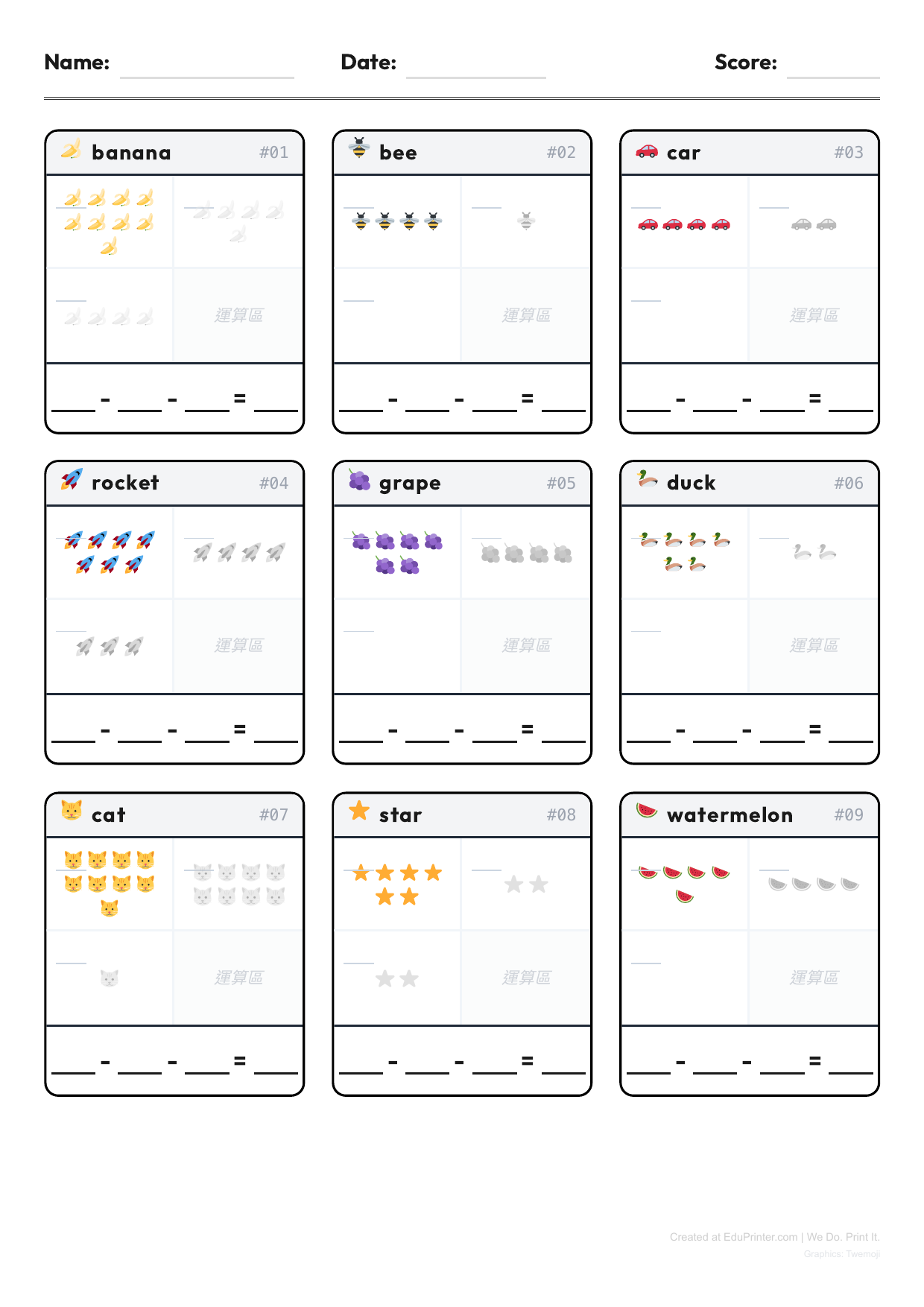
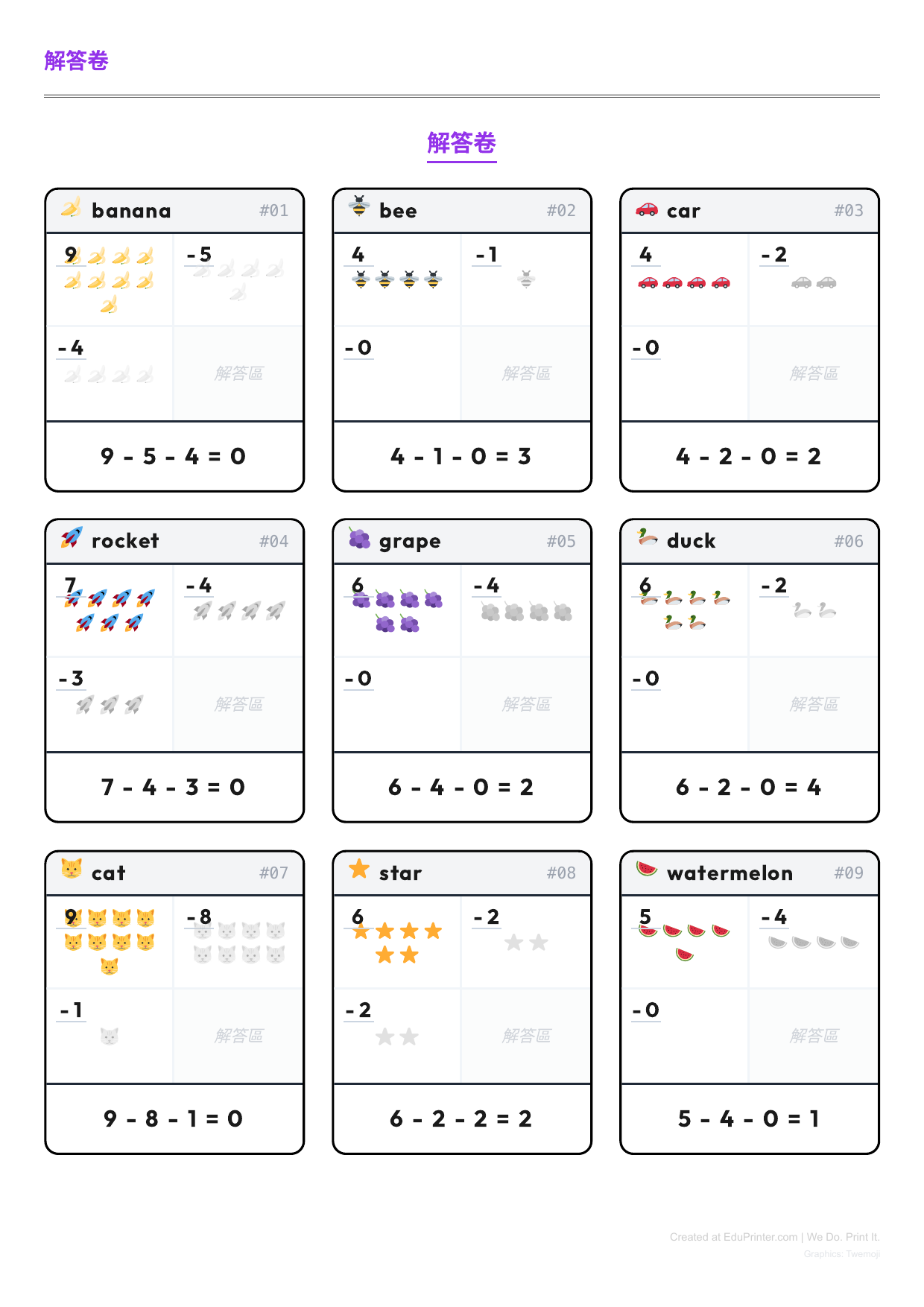
Unlike traditional worksheets that only draw strike-through lines, we use transparency and grayscale effects to process the "subtrahend" images. This creates strong visual contrast: **solid items (minuend)** versus **faded items (subtrahend)**. Children can intuitively understand: "These faded apples are the parts that were taken away or eaten."
2. Structured Three-Part Layout
Each problem is clearly divided into three sections: total, first part subtracted, second part subtracted (depending on difficulty). This structured presentation helps children establish the relationship between "whole" and "parts" (Part-Whole Relationship), which is an important foundation for future learning of fractions and algebra.
3. Storytelling Math Time
Using these vivid Twemoji illustrations, you can play "storytelling math" with your child. For example: "There were originally 10 cars (pointing to the first grid), 3 drove away (pointing to the faded second grid), and 2 more drove away (pointing to the faded third grid). How many cars are left in the parking lot?" Through narrative, math is no longer cold formulas but interesting life scenarios.
Flexible Adjustment, Adaptive Teaching
Every child learns at a different pace. You can freely adjust difficulty (sums from 5 to 20) in settings, or choose whether to "show numbers." For children just starting, we recommend enabling number display first to build confidence; after proficiency, turn off numbers to strengthen mental arithmetic and counting skills.
Not Just Calculation, But Logic Enlightenment
Subtraction is an important part of logical thinking. By observing changes in graphics, children learn not just "calculating answers" but "observing differences" and "understanding cause and effect." Print out a fun pictorial subtraction worksheet now and lead your child to experience the surprising moment of "wow, math is this fun!"
Experience the Magic of Visual Subtraction
Customize and download exclusive worksheets immediately, making learning more fun.
Generate Pictorial Subtraction Worksheet